4 tips to sharpen your skills for your first PR agency role
Most college seniors pursuing careers with public relations agencies commonly wonder: What soft skills should I master to set myself up for success? A quick search reveals tips that focus on staying organized, managing time efficiently and communicating clearly. These skills matter, but they often lack meaningful elaboration on what it means to apply them to an agency role.
These adages tell only part of the story. In practice, it quickly becomes clear that success in an agency depends on developing a strong sense of judgment in real time. The learning curve centers less on checking the boxes of the right skills and more on applying them in a dynamic environment. Each day presents many opportunities to make thoughtful decisions that shape your work and your team’s momentum. With discernment, you can prioritize effectively and stay proactive when everything feels important.
Strong judgment makes work smoother, teams more aligned and client relationships stronger. While some skills may not always be explicitly taught in schools or covered in job descriptions, they can be practiced early and developed intentionally. The following lessons and habits support a successful transition to agency life and can help prepare you for your first agency role.
Learn what truly needs attention
One of the most valuable lessons in agency life is realizing that not everything can be planned well in advance or treated with the same level of urgency.
In school, leadership roles and internships, deadlines and expectations are often clearly defined. Of course, there are exceptions, but the ability to plan ahead is more straightforward. In a public relations agency, however, priorities frequently overlap and evolve.
This is where strong judgment and a good understanding of your clients are essential. Ask yourself, “What is truly time-sensitive versus what simply feels immediate?” or “What is most important to the client, and what will really move the needle to accomplish their goals?” While timeliness is important, not everything is a fire drill, and not every detail carries equal weight. Learning what truly matters for your clients builds both efficiency and trust with your team. That distinction shapes how energy is spent and the quality of the output.
Practice: Before starting an agency role, practice making prioritization decisions under limited time conditions and with competing demands. Set a fixed window between 60-90 minutes to rotate through multiple task types at once (reading, writing, editing, etc). Challenge yourself to decide what should get done first and what can be delayed. The goal of this exercise is to strengthen your ability to quickly and repeatedly prioritize tasks. Building this muscle will help you distinguish what is truly high-priority versus what just feels pressing, so you don’t rush through any given task. And ultimately, clients receive the best possible version of your work.
Take initiative and be resourceful
Agency environments move quickly. One of the most valuable habits you can build early is learning when to ask a question and when to take initiative to find the answer yourself. It’s a constant balancing act to show up as a proactive team member.
On the one hand, always jumping to ask questions without looking first displays a lack of resourcefulness and takes valuable time away from your team members to share readily available information. On the other hand, not asking enough questions and relying on your own search for answers for an extended period leads to wasted time and unnecessary stress. Clear direction benefits everyone.
When a question arises, it’s important to evaluate its urgency, complexity and whether relevant knowledge can be found with ease. Equally important is crafting questions that are clear and direct to prevent confusion. Questions should transition from “What should I do?” to “Here’s what I’m seeing, here’s what I’ve tried and here’s where I’m stuck,” which helps save time and provide clarity on both sides.
You can use the grid below to help guide your decisions for when to ask a question:
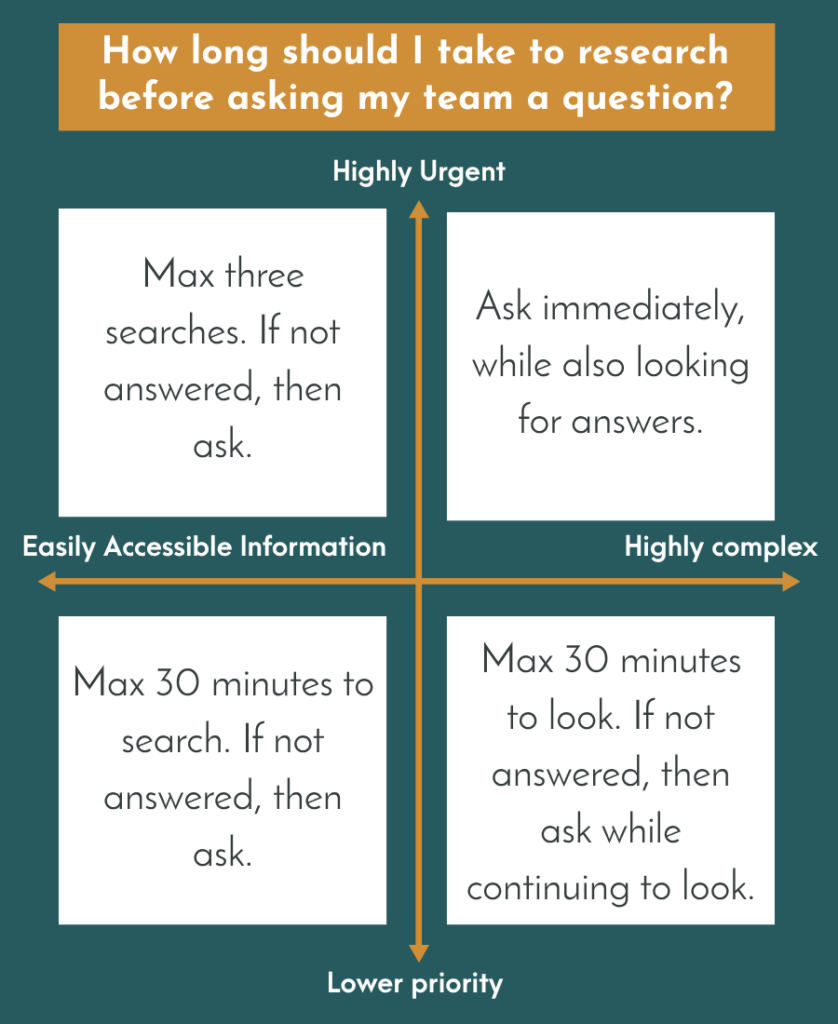
Judgment and curiosity go hand in hand with being resourceful and taking initiative. The most effective team members balance independent efforts, curiosity and timely communication. Testing and sharing ideas, even at the risk of being wrong, fosters growth for both individuals and teams. In practice, resourcefulness is what turns uncertainty into progress. It keeps work moving while also creating a space for learning through doing.
Build relationships through everyday interactions
Relationship building, both internally and externally, is all about intentional choices in how you communicate. Most time will be spent creating similar deliverables to share with your team or clients. Learning and remembering people’s communication preferences and preferred medium will make a meaningful difference by increasing their trust in your work and demonstrating your ability to listen. Keep an ongoing list of these details to refer to in the future, and to use your best judgment about when those details are applicable.
The same applies to email communications and building relationships digitally. With a significant percentage of the U.S. workforce working from home, either in a hybrid or fully remote setup, learning to build relationships online has become a priority and an art form. Emails have become a primary way of communicating, especially with clients, so tone and clarity matter just as much as the content.
Strike a balance between being concise without coming across as cold, friendly without being informal and efficient without losing context. Always start with a friendly opening, bolding key due dates and asks, offering calls (phone or video conference) to further clarify and adding relevant personal details. Applying these tricks and learning to discern what is appropriate to include in an email will help build the relationship, even when most interactions aren’t face-to-face.
Practice: To become more comfortable with the different messaging in agency work, write and rewrite the same message in multiple tones and formats. For example, simulate PR agency communication by writing an email, then cutting it by 30% without losing meaning. Upon review, identify the main points and determine whether the email includes a clear ask or deadline. Also, check the tone: is the email professional and friendly enough to build or strengthen the relationship?
Make good habits sustainable through systems
Now that you’ve learned to prioritize tasks, be resourceful, take initiative and build relationships, the last piece is making these skills and practices sustainable.
Strong systems create stability even in a fast-paced environment. In an agency setting, especially if working from home, communication priorities and fast-turnaround requests often arise. While these interruptions can’t be avoided, preparation using time-management skills is key. Creating uninterrupted focus time or calendar blocks, even if brief, can significantly improve the quality of thinking and output. For larger projects, breaking them down into smaller subtasks with strategic timing improves efficiency and delivers better results.
Another valuable trick is tracking how long tasks actually take. Many professionals underestimate or overestimate their timing early in their careers, so developing the habit of measuring time helps improve future planning.
Once starting a new role, create a simple system to track recurring tasks. Estimate the time needed, record the actual time spent and reflect on what influenced any difference. Consider whether interruptions caused delays, over-editing affected progress or if a clarifying question was not asked in a timely manner. Use these insights to improve the next time block. Over time, a system emerges from personal workflow rather than from assumptions about how work should be done.
Example template for task and time tracking:
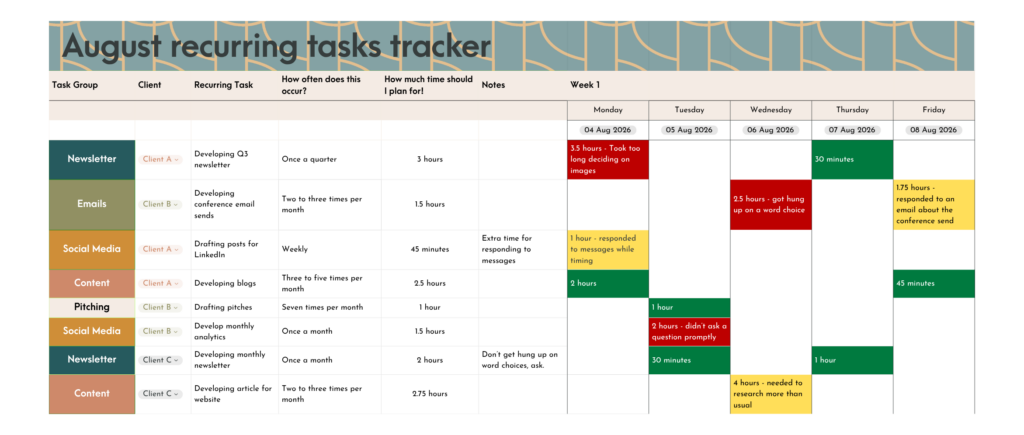
Learning how to manage your time and regularly evaluate the system you created will lead to continuous improvement in your role.
Agency success is built through small habits practiced consistently over time, including strong judgment, clear communication, thoughtful initiative and systems that sustain good work. Developing these habits early smooths the transition into agency life and supports long-term success in your future role!
Reese Brosnan is an account coordinator at Pierce Public Relations, a Nashville-based strategic PR and marketing firm specializing in the architecture, engineering and construction (AEC) industry and firms serving the built environment. Connect with Reese at reese@pierce-pr.com or on LinkedIn.